---
title: SaaS Offboarding Without IAM Tools (Guide for small businesses)
description: Streamline employee offboarding, reduce security risks, and save time without expensive IAM solutions. Discover how Substly helps SMBs manage offboarding.
image: https://www.substly.com/hubfs/Streamline%20employee%20offboarding%20without%20expensive%20IAM%20tools%20800px.png
---
[Skip to content](https://www.substly.com/en/blog/how-smbs-can-streamline-employee-offboarding-without-expensive-iam-tools#main-content)
- [How it works](https://www.substly.com/en/how-it-works)
- [Pricing](https://www.substly.com/en/pricing/)
- [Customer cases](https://www.substly.com/en/customer-cases)
- [Blog](https://www.substly.com/en/blog)
- [Sign in](https://app.substly.com/login/)
- [Sign in](https://app.substly.com/login/)
- [Start here](https://www.substly.com/en/try-substly-for-yourself-book-a-walkthrough)
# SaaS Offboarding Without IAM Tools (Guide for small businesses)
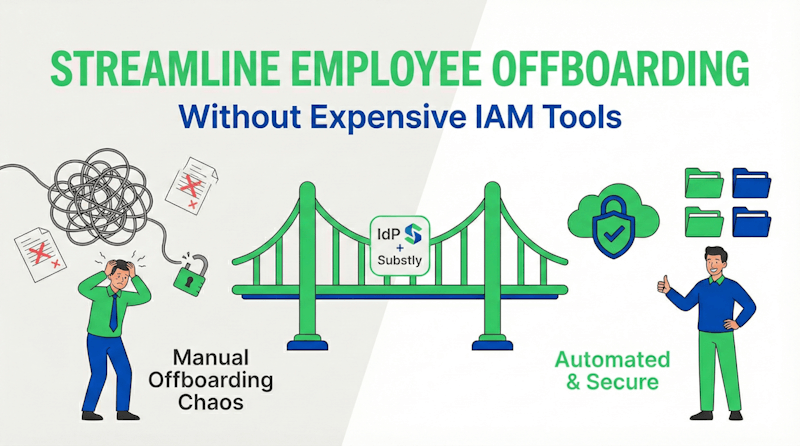
**Offboarding is one of the most overlooked key processes in growing organizations — and one of the most significant security risks. Yet most small and medium-sized companies don’t have the budget or need for enterprise IAM tools. Here’s how SMBs can create a secure, scalable offboarding workflow using tools they already have.**
**Key Takeaways**
- Offboarding doesn’t need to be chaotic, risky, or take up a lot of human resources — even for SMBs.
- 70% of businesses have experienced business disruption, security incidents, or wasted spending as a direct result of ineffective employee offboarding.
- With your existing identity platform plus a smart workflow tool like Substly, you can avoid unacceptable security risks and efficiently manage departing employees without investing in heavy IAM infrastructure.
## What User offboarding means (and why it matters)
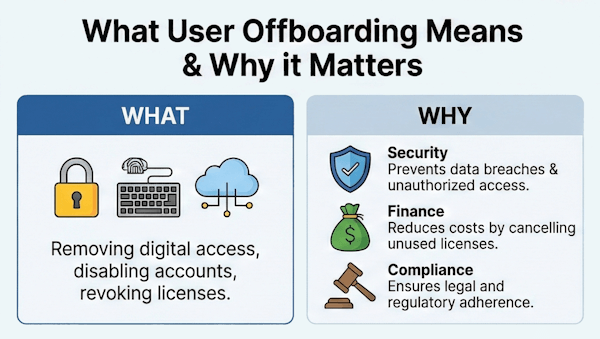
When an employee leaves your organization, the offboarding process involves removing their access to Saas apps, licenses, and services. It’s not just good housekeeping — employee SaaS offboarding is critical for both cost control and security. Unrevoked access creates risk. Unused licenses cost money.
According to a survey by [Nudge Security](https://www.nudgesecurity.com/post/employee-offboarding-by-the-numbers), 70% have experienced business disruption, security incidents, or wasted spending as a direct result of ineffective employee offboarding. In the same survey, Nudge Security also discovered that businesses spent **an average of five hours per employee** on cloud and SaaS access offboarding for departing employees.
## Why offboarding is still hard for SMBs
Modern identity platforms such as **Microsoft Entra ID** or **Google Workspace** provide powerful tools for managing user accounts. And when a SaaS service supports standards like **SSO** or **SCIM (System for Cross-domain Identity Management)**, both provisioning *and* deprovisioning can usually be automated.
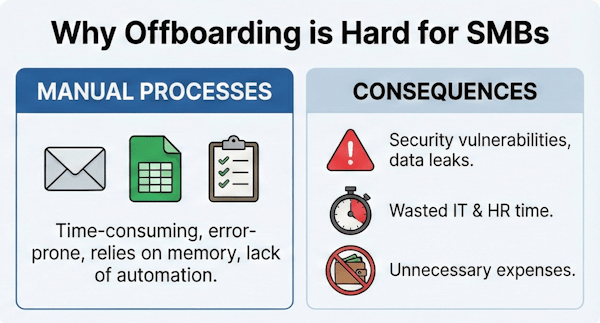
The challenge is this: many SaaS vendors only provide SSO/SCIM features on their **Enterprise plans**, which often cost **4–5x more** than the standard plans. This makes full automation of company software economically impractical for many smaller companies.
As a result, SMBs end up with a mix of:
- SaaS apps where automation *is* available and is handled by Entra ID/Workspace
- And many SaaS apps where automation is *not* available under their current plan, so manual offboarding steps are required
Without a structured process to manage both automated and manual cases, gaps and delays creep in—and the risk of human error increases.
## How to bridge the gap
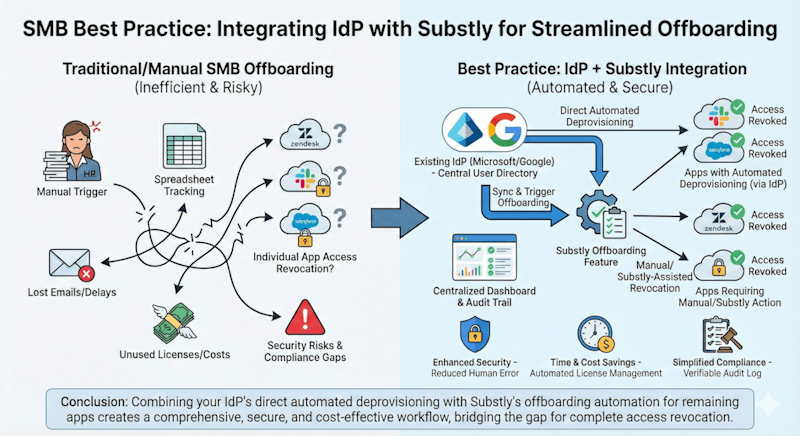
Here’s where **Substly** comes in, working alongside your identity platform, not replacing it.
- For the services that *do* support an automated deprovisioning process (via SSO/SCIM), your identity system handles the deprovisioning.
- For services that *don’t* support full automation under your plan, Substly picks up the rest of the workflow.
### **Offboarding workflow**
1. **1.** The offboarding for the departing employee is triggered.
2. **2.** User access is automatically revoked for SaaS apps with automated deprovisioning enabled in your Microsoft Entra ID or Google Workspace.
3. **3.** Substly identifies all other services assigned to the departing user.
4. **4.** Substly sends notifications to each service owner with a direct link to remove the account.
5. **5.** Service owners click to confirm removal.
6. **6.** The admin view in Substly shows live status — who’s done, who’s pending, and sends reminders when needed.
7. The service owner's task is simple — just a few clicks. Admins get visibility and actionable insight.
## Ideal employee offboarding software setup for SMBs
Most SMBs do *not* need a dedicated IAM tool like **Okta** or **OneLogin**. These enterprise-grade platforms bring power, but also complexity and cost.
For most SMBs, the smarter configuration is:
**Entra ID or Google Workspace + Substly**
This setup gives you:
- Identity lifecycle automation where it’s available
- A secure, managed offboarding workflow where it’s not
- Visibility, status tracking, and reminders of departing and former employees
- No need to invest in expensive enterprise IAM stacks or other employee offboarding software
[](https://www.substly.com/hubfs/The%20value%20of%20automated%20offboarding%20for%20SMBs.png)
## The value you get
**Time savings**: Substly customers report up to **90% less time** spent on offboarding after introducing this workflow (mirroring findings around average 5-hour spend per user across the whole organization found by Nudge Security).
**Reduced risk**: Fewer lingering accounts of former employees, better visibility, fewer gaps.
**Cost control**: You reclaim unused licenses faster and reduce waste.
**Low friction**: The workflow is simple for service owners and centralized for admins.
---
*If you work in a small or medium-sized business and are looking for a user-friendly SaaS management platform with a short learning curve to help you identify and manage SaaS tools, consider* [*exploring Substly*](https://app.substly.com/register/) *on your own or* [*getting a demo*](https://www.substly.com/en/book-demo/) *to see if it suits your needs.*

## SaaS Management Automation for small businesses: Benefits & Best Practices
## The Increased Risk of Shadow IT in the Shadow AI Era

## SaaS management for CTOs; Increase Security and Save Money
English
Substly
- [How it works](https://www.substly.com/en/how-it-works)
- [Become a partner](https://www.substly.com/en/become-a-partner)
Learn more
- [Blog](https://www.substly.com/en/blog)
- [Customer cases](https://www.substly.com/en/customer-cases)
- [About us](https://www.substly.com/en/about-us/)
Application
- [Sign in](https://app.substly.com/login/)
- [Book a demo](https://www.substly.com/en/book-demo/)
- [Contact sales](https://www.substly.com/en/contact-sales)
- [Help center](https://help.substly.com)
Resources
- [SaaS Management: What is it, tips for getting started & best practices](https://www.substly.com/en/blog/what-is-saas-management)
- [SaaS Management Platforms for SMBs - a Comprehensive Guide](https://www.substly.com/en/blog/saas-management-platforms-for-smbs-a-comprehensive-guide)
- [Automation of SaaS Management in small and medium-sized businesses](https://www.substly.com/en/blog/automation-of-saas-management-in-small-and-medium-sized-businesses)
- [Managing the Risks of SaaS Sprawl and Shadow IT](https://www.substly.com/en/blog/managing-the-risks-of-saas-sprawl-and-shadow-it)
- [9 SaaS Management Best Practices for Small Businesses](https://www.substly.com/en/blog/9-saas-management-best-practices-for-small-businesses)
- [When should you invest in a SaaS management platform?](https://www.substly.com/en/blog/when-should-you-get-a-saas-management-platform)
---
© 2026 Substly AB. All rights reserved.
[**Terms & conditions**](https://www.substly.com/en/terms-conditions/)
[**Privacy policy**](https://www.substly.com/en/privacy-policy/)
[](https://www.g2.com/products/substly/reviews)
[](https://www.capterra.com/p/211769/Substly/reviews/)
[](https://www.capterra.com/p/211769/Substly/)
[](https://www.capterra.com/p/211769/Substly/)
```json
{
"@context" : "https://schema.org",
"@type" : "BlogPosting",
"author" : {
"@type" : "Person",
"name" : "Ola Stål",
"url" : "https://www.substly.com/en/blog/author/ola-stål"
},
"dateModified" : "2026-05-12T12:12:25.563Z",
"datePublished" : "2025-12-12T06:10:07.000Z",
"headline" : "SaaS Offboarding Without IAM Tools (Guide for small businesses)",
"image" : [ "https://www.substly.com/hubfs/Streamline%20employee%20offboarding%20without%20expensive%20IAM%20tools%20800px.png" ],
"mainEntityOfPage" : {
"@id" : "https://www.substly.com/en/blog/how-smbs-can-streamline-employee-offboarding-without-expensive-iam-tools",
"@type" : "WebPage"
},
"publisher" : {
"@type" : "Organization",
"logo" : {
"@type" : "ImageObject",
"url" : "https://www.substly.com/hubfs/substly-logo.svg"
},
"name" : "Substly"
}
}
```